Literarisches & Journalistisches

Fractured reality: How democracy can win the global struggle over the information space
09. April, 2026The report examines the evolving impact of digital technologies on European democracy. In an era of a global struggle to control the information space, this report offers critical insights into the fracturing of perceived realities, the rise of the ”fantasy-industrial complex,” and the systemic risks posed by the attention economy. It exposes how platforms algorithmically prioritise engagement over accuracy, reinforcing ideological echo chambers and amplifying mis- and disinformation that erode democratic resilience. The report highlights how structural incentives and foreign control of the most important players in the information space undermine information integrity, collective knowledge and civic discourse. In response, the report presents a number of recommendations from fostering alternative public spaces and crowd-sourced knowledge systems to reforming business models, restoring user agency, and advancing EU digital sovereignty through decentralised infrastructure.
The Normative Power of Artificial Intelligence
11. Oktober, 2023Artificial intelligence technologies are spreading across society. Generative systems, such as ChatGPT and DALL-E, provide only some examples of the expanding consumption and commodification of artificial intelligence applications in daily life. Nonetheless, the extensive trust and reliance on these technologies in public and private sectors is raising questions for the rule of law. Artificial intelligence technologies are not only mere tools which challenge the protection of fundamental rights when these systems moderate online speech, check employment performances in the workplace, and evaluate credit scores. Particularly, machine learning technologies also contribute to creating norms and rules shaping the enforcement of their functions, thus defining another generative layer of normativity competing with the rule of law in the algorithmic society. This work argues that artificial intelligence systems, particularly machine learning, develop norms by experience and learning within an opaque, technical space. The norms governing these systems are not always immutable but shaped across time. In the algorithmic society, code is not only law but also a source of law. The consolidation of this normative power, or the rule of tech, raises questions for constitutional democracies that are already struggling with solutions to limit other forms of normativity, primarily the predominance of online platforms in the setting of transnational private standards. This plurality of sources has put the rule of law under pressure. The expansion of the rule of tech as a source of norms leads to addressing the spaces for the rule of law and the limits of powers in the algorithmic society, as underlined by the European regulatory approach on artificial intelligence. Within this framework, this work analyses the challenges raised by the normative power of artificial intelligence systems and examines the spaces for the rule of law in the algorithmic society.

The Dutch tax authority ruined thousands of lives after using an algorithm to spot suspected benefits fraud — and critics say there is little stopping it from happening again.
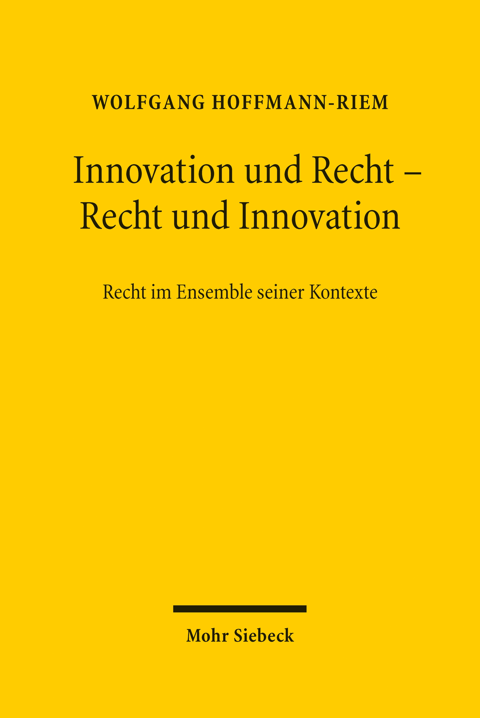
Wolfgang Hoffmann-Riem behandelt in seiner interdisziplinär ausgerichteten Monographie aktuelle Grundsatzfragen der Setzung und Anwendung von Recht mit dem Blick auf seine Bedeutung für soziale und technische Innovationen. Die Besonderheiten von "Innovationen durch Recht" und von "Innovationen im Recht" werden an verschiedenen rechtlichen Instrumenten sowie in Beispielsfeldern aufgezeigt.
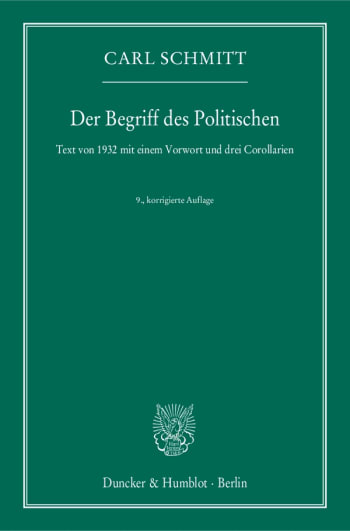
»Es soll [...] ein Rahmen für bestimmte rechtswissenschaftliche Fragen abgesteckt werden, um eine verwirrte Thematik zu ordnen und eine Topik ihrer Begriffe zu finden. Das ist eine Arbeit, die nicht mit zeitlosen Wesensbestimmungen anfangen kann, sondern zunächst einmal mit Kriterien ansetzt, um den Stoff und die Situation nicht aus den Augen zu verlieren. Hauptsächlich handelt es sich dabei um das Verhältnis und die gegenseitige Stellung der Begriffe Staatlich und Politisch auf der einen, Krieg und Feind auf der anderen Seite, um ihren Informationsgehalt für dieses Begriffsfeld zu erkennen.«